
From menu engineering to smarter sourcing, Australian hospitality operators are finding practical ways to hold their margins as ingredient and supply costs climb. These are the strategies working right now.
At a glance
- Food costs rose 3.1% and electricity jumped 25.4% in the year to March 2026, putting pressure on already tight hospitality margins.
- Operators who reduced menu size by 20% or more improved cost control, reduced waste and increased service speed.
- Up to 10% of food spend can be lost to waste, but tighter stock management and prep discipline can recover significant costs.
In the year to March 2026, food costs rose 3.1% and electricity jumped 25.4% after government rebates expired. Customers under cost-of-living pressures are cutting back on dining out. Between the two, 60% of venue operators now describe their financial health as struggling or worse, according to a Broadsheet and Square survey.
This article covers practical steps you can take in response, including actionable strategies from Matteo Corno, Operations Manager across Pelicano Restaurant, Sentiti Bene café and Society Pizza Catering in Sydney.
Your menu is your biggest margin lever
More than half of Australian restaurants reduced their menu size in 2025, and operators who cut by 20% or more saw material improvements in cost control and speed of service, according to the Restaurant & Catering Association’s 2026 outlook. Fewer items mean less inventory sitting in your cool room, less waste, simpler prep and fewer things going wrong during a busy service.
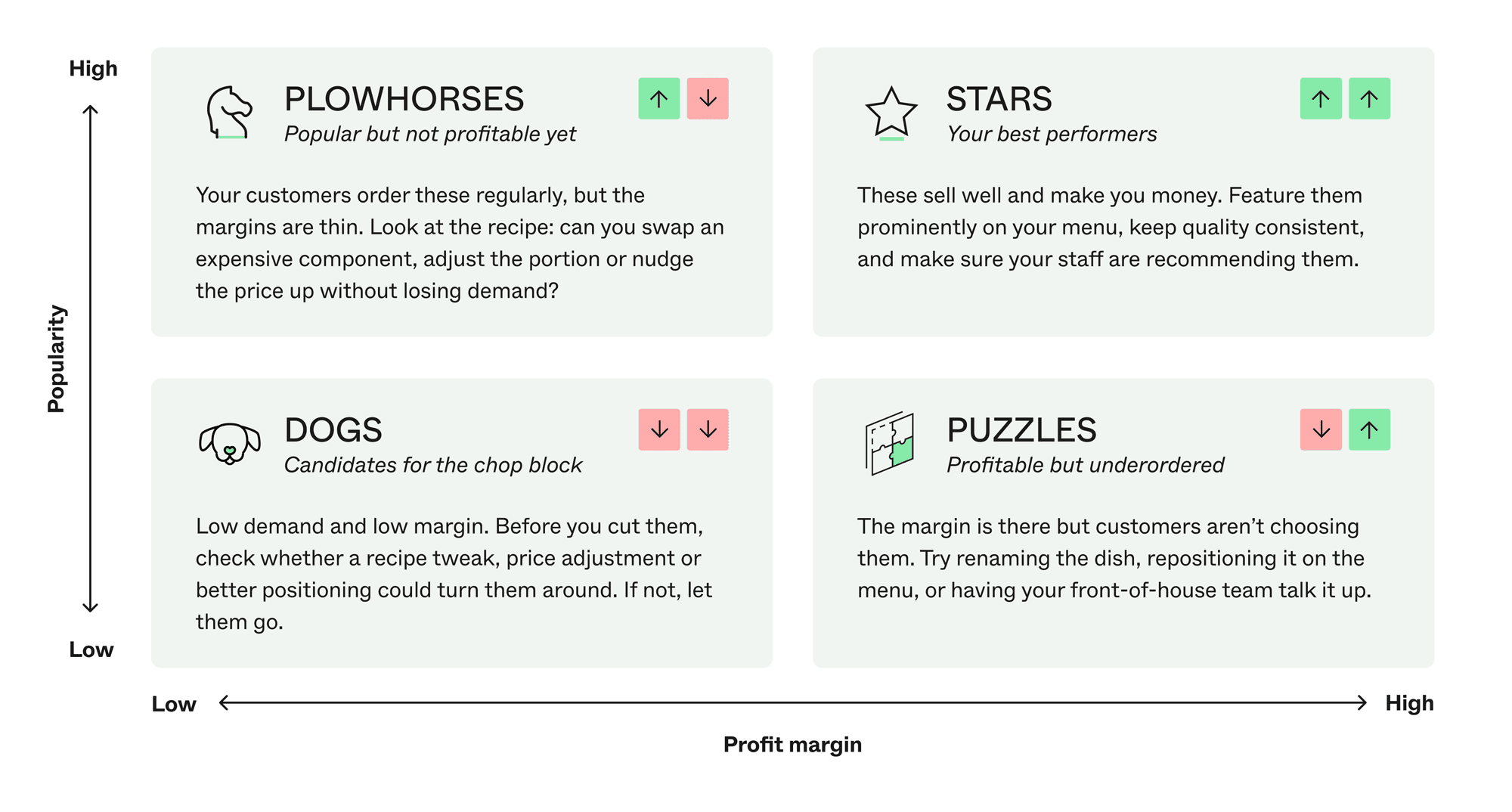
Start by ranking every dish on two axes: food cost percentage and popularity. The framework is called menu engineering, and it sorts your menu into four categories:
- Stars (high margin, high popularity): promote these, feature them prominently and make sure staff are recommending them
- Plowhorses (low margin, high popularity): re-engineer the recipe, adjust the portion or nudge the price up
- Puzzles (high margin, low popularity): reposition on your menu, rename the dish or have front-of-house talk them up
- Dogs (low margin, low popularity): cut them, unless a recipe tweak or better positioning can turn them around
Melbourne-based training platform Typsy runs a practical course on the process if you want to go deeper.
The RCA outlook also points to a “two-speed menu” as the emerging model: a tight core built for margin and consistency, paired with rotating specials for seasonal dishes and premium pricing. The core keeps your kitchen fast and your costs predictable. The rotating side gives customers a reason to come back and lets you charge more for limited-availability items.
Before you raise prices on an underperforming dish, check whether adjusting the portion or swapping a component gets you there. A slightly smaller protein serve with a more generous side of seasonal vegetables can shift a dish from a Plowhorse to a Star without changing the price on the menu.
Lean into seasonal and local sourcing
The gap between inflation categories tells you where to look. Vegetables rose just 1.8% over the past year, compared with 11.8% for beef and 15.5% for lamb. A menu that leans harder into seasonal vegetables, chicken, eggs and legumes reduces your exposure to the categories climbing fastest.
An RMIT University study for End Food Waste Australia found that cafés with shorter, seasonal menus wasted less food and had better stock control, particularly when they built flexibility into recipes through ingredient substitution (seasonal pesto, chutney or jams instead of fixed components).
Matteo Corno runs all three venues he manages out of one centralised kitchen. “That’s the thing that protects us,” he says. “It’s why we don’t suffer.” The shared kitchen lets him consolidate purchasing, align menus around overlapping ingredients and rotate stock between venues before anything goes to waste.
Building direct relationships with local growers shortens your supply chain, reduces transport costs and gives you more flexibility when prices move. Corno sources locally where he can, particularly after seeing sharp price increases on imported Italian flour.
This works at every scale. A café can move from a fixed sandwich menu to a daily board built around what arrived that morning. A restaurant can anchor its core menu around cost-stable proteins like chicken and build seasonal interest through vegetable-forward specials. A bakery seeing sugar and chocolate prices climb can introduce savoury lines or fruit-based pastries using whatever is cheap and plentiful right now.
Turn food waste into savings and a selling point
Up to 10% of food purchased by restaurants is lost to waste or inefficiency. If your weekly food spend is $3,000, that’s $300 a week, and $15,600 a year. RMIT’s research found that up to 60% of an average café’s bin is filled with food, including edible, usable produce that could have been served.
A one-week waste audit is the fastest way to find where the money is going. Weigh and log what you throw out by category: prep trim, spoiled stock, uneaten portions, over-production. That baseline tells you what to fix first. From there:
- Implement FIFO (first in, first out) stock rotation
- Use off-cuts for stocks, sauces, staff meals and specials
- Batch prep to match expected covers, not maximum capacity
- Build flexibility into your recipes so you can use what’s on hand
Corno’s three-venue model takes this further. “Fresh mushrooms go on the pizza, cooked mushrooms go to catering, and frozen to the sandwich bar,” he says. “All the products can be rotated across the three businesses.” Even if you’re running a single venue, the principle applies: design your menu so ingredients can move between dishes rather than sitting in the cool room until they’re thrown out.
To help you turn waste into savings, we’ve put together a free one-page waste audit template you can print, stick near the bins and fill in over five days.
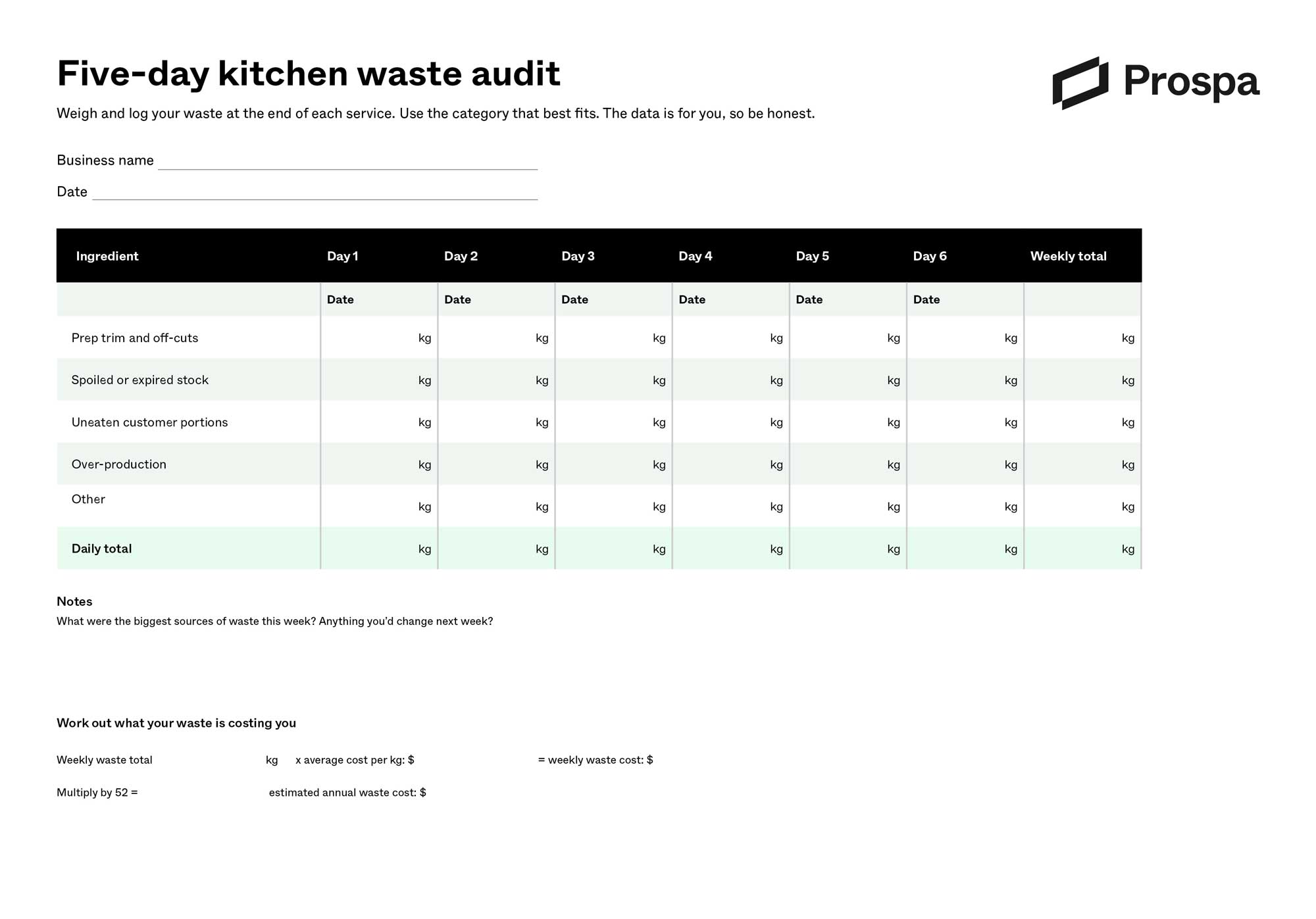
Download the kitchen waste audit template
There’s a customer-facing angle too. A café that says “we’d rather sell out than throw out” is making a values statement that lands with conscious diners. Some venues communicate this through menu notes explaining that dishes rotate based on what’s fresh, or by briefing front-of-house staff to frame limited availability as intentional. For younger demographics especially, sustainability sells, and it costs nothing to talk about what you’re already doing.
Tighten how you buy and track stock
If you’re ordering from memory or a notepad, you’re probably losing margin without seeing it. Inventory tracking has a direct line to profitability, yet plenty of small venues still rely on partially manual systems. Even a basic spreadsheet that logs what you receive, use and throw out each week is a step up.
Set par levels (the minimum stock you want on hand for each ingredient) for your highest-cost items based on actual usage, not habit or what your supplier’s rep suggests. Review whether your ordering frequency matches real turnover: smaller, more frequent orders can reduce spoilage even if per-unit cost is slightly higher.
Supplier pricing on the same product can vary 10–20% between wholesalers. If you haven’t compared prices recently, that’s one of the fastest wins at hand. Knowing the market rate for your staples gives you the conversation to have with your current supplier before your next order.
Our free supplier price comparison template gives you a simple one-page grid to compare your top 10 ingredients across three suppliers and work out where you could be paying less.
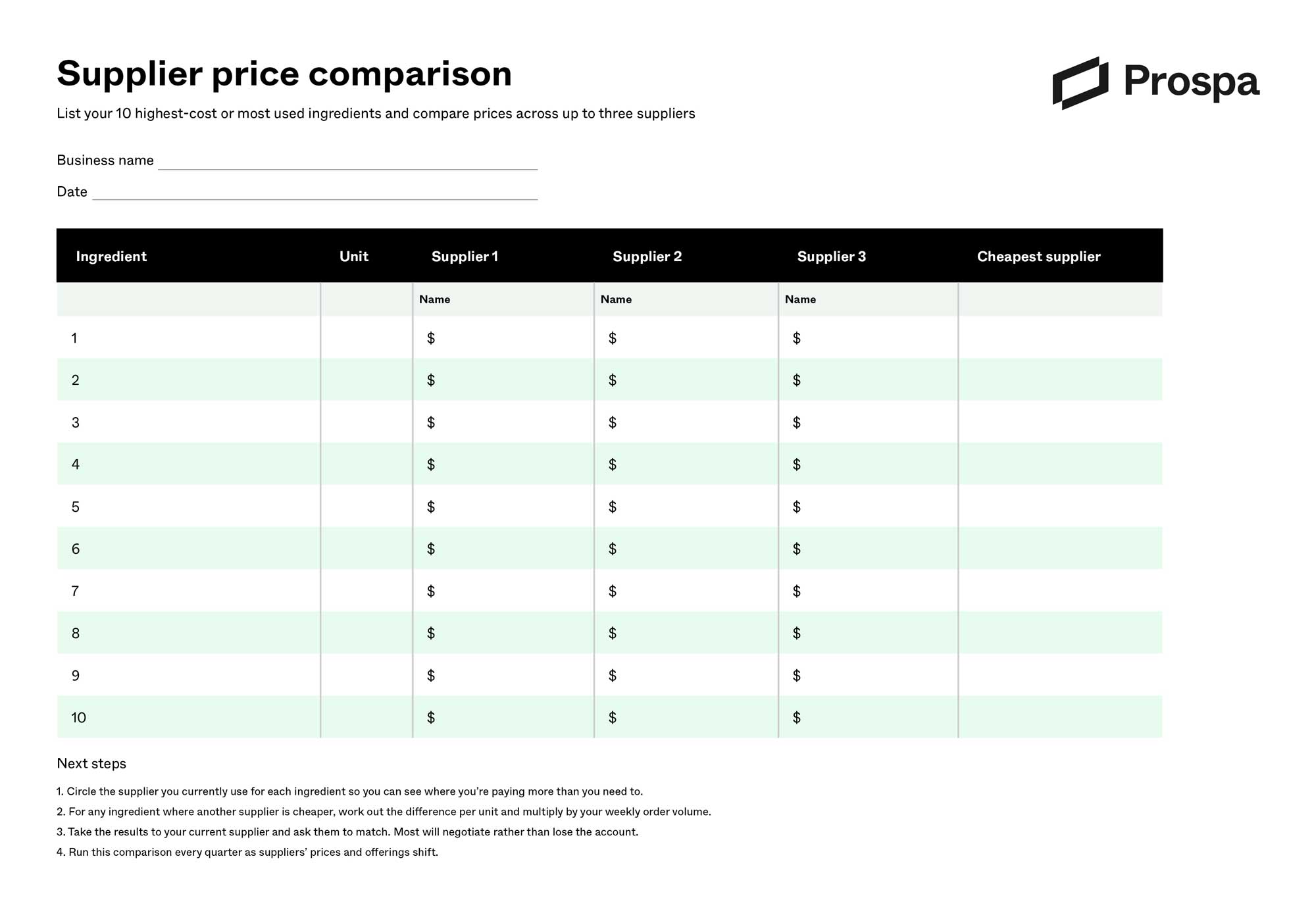
Download the supplier price comparison template
Long-term supplier relationships can unlock savings that go beyond price matching. Corno has worked with the same core suppliers for over 10 years. “Instead of buying 10 bags of flour, I commit to buying 100 at a better price,” he says. “That’s what a 10-year relationship with your supplier gives you.” Those relationships have also meant access to credit during cash flow gaps and the flexibility to negotiate new terms as costs shift, something a newer supplier relationship rarely offers.
Cut your energy bill before it cuts your margin
With electricity one of the fastest-rising costs on your P&L, your energy bill deserves the same attention as your food spend, especially when your venue runs commercial ovens, fridges, dishwashers and HVAC all day.
The most effective fixes are often maintenance-based. Dirty condenser coils on commercial fridges and freezers increase energy consumption by 25% or more. Scheduling ovens and dishwashers outside peak tariff periods reduces costs without changing output. LED lighting, if you haven’t switched already, pays for itself within months. And getting competing quotes on your energy plan takes an afternoon.
If you’re looking at replacing an ageing fridge or upgrading to a more efficient oven, the instant asset write-off (now permanent at $20,000 per asset) lets you deduct the full cost in the year of purchase. If the equipment saves $2,000-$3,000 a year in energy, the upgrade can pay for itself faster than you’d expect. The small business tax deductions guide covers how to make the most of deductions before 30 June.
If your business also runs deliveries or vehicles, whether you operate a food truck, a catering company or multiple sites, the guide to managing fuel costs covers strategies for that side of the expense sheet.
Price with precision, not apology
In hospitality, pricing adjustments work best when they’re targeted rather than across the board. Small, regular increases are less noticeable than one large jump. Two 4% adjustments spread across your menu over six months are easier for customers to absorb than a single 8% round.
Focus increases on premium items where customers already expect value: specialty coffee, signature dishes, anything with a story or perceived scarcity. For example, with coffee bean prices surging globally after poor harvests in Brazil and Vietnam, customers are already primed to accept that a good cup costs more.
Where you place your dishes on the menu matters as much as the prices themselves. A premium dish at $38 makes the $24 option feel like a reasonable choice. A $7 single-origin pour-over makes the $5.50 flat white feel like good value.
Customers notice price changes whether you flag them or not, so be upfront about it. A brief, honest explanation on a menu insert or from front-of-house staff builds more trust than hoping nobody will look too closely.
For more pricing strategies, read our guide on 9 ways to protect your margins when costs keep climbing.
Bridge the gaps with the right funding
Hospitality cash flow is lumpy by nature, and the right funding can smooth it out.
A business line of credit can cover stock purchases ahead of a busy period, bridge a slow month or fund equipment that reduces ongoing costs. You draw what you need, when you need it, and only pay interest on what you use. A small business loan suits a larger one-off investment, like a kitchen fit-out or a piece of equipment that qualifies for the instant asset write-off.
The operators who manage through stretches like this tend to be the ones who arranged their options before things got tight.
If you want to understand what funding is available before you need it, you can check your eligibility with Prospa in under 10 minutes.