
At a glance
- From 1 July 2026, any business sending text messages under a branded name (like "JoesPlumbing" instead of a phone number) must have that name registered on ACMA's new SMS Sender ID Register.
- If your sender ID isn't registered, your messages will be labelled "Unverified" and grouped with potential scam texts, which means customers may ignore or delete them.
- If you use a third-party platform that sends SMS on your behalf (a booking system, CRM, or marketing tool), don't assume registration has been handled; contact your provider to confirm.
You might already be sending branded text messages without realising it. If you use a booking system, CRM, or marketing platform that texts your customers, there’s a good chance those messages display a business name rather than a phone number. New rules from the Australian Communications and Media Authority (ACMA) mean that name now needs to be registered, and the deadline is weeks away. This is one of several compliance changes landing in 2026 that small business owners should have on their radar.
Here’s what’s actually changing, how to tell if it affects you, and what to do about it.
What’s a sender ID and what’s changing?
When you receive a text message from a business, the name at the top of the message is the sender ID. Instead of a phone number, you’ll see something like “ATO,” “myGov,” or a business name like “ParkRun” or “JoesPlumbing.” That name is what ACMA is now regulating.
As part of the government’s Fighting Scams initiative, ACMA has created an SMS Sender ID Register. From 1 July 2026, every branded sender ID used to message Australian mobile numbers must appear on that register. If it doesn’t, the message will be stamped with an “Unverified” label and grouped alongside suspected scam messages on the recipient’s phone. Branded messages from telcos that haven’t joined the register scheme will be blocked entirely.
Does this apply to your business?
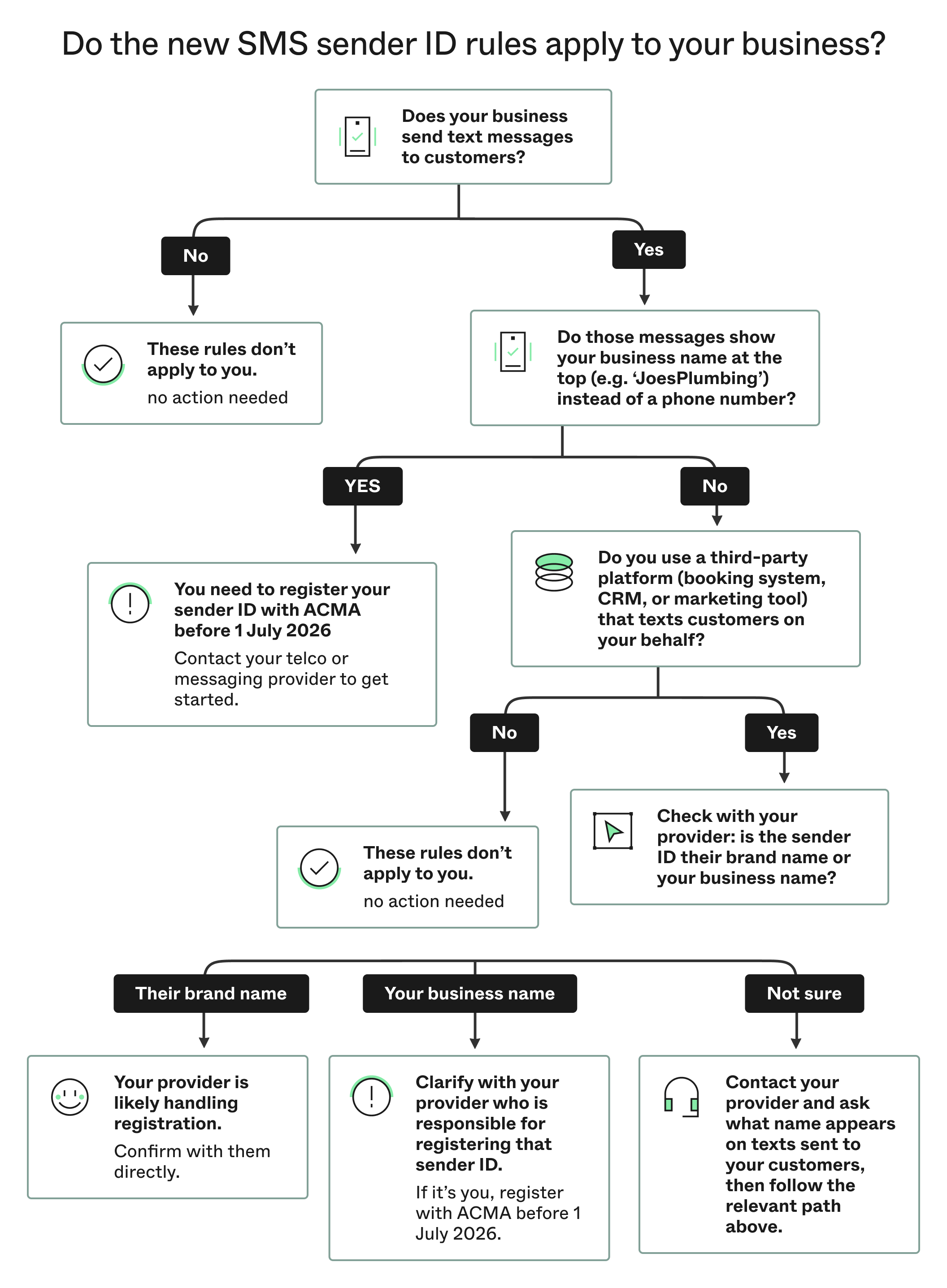
The quickest way to work it out is to think about what your customers see when they receive a text from you.
If what they see is “JoesPlumbing” or “BellaCafe” at the top rather than a mobile number, that’s a branded sender ID, and it needs to be registered, whether you’re sending appointment reminders, delivery updates, or marketing promotions.
If you only text customers from a standard mobile or landline number, the new rules don’t apply to you.
The less obvious scenario is when you’re not sending those texts yourself. If you use a booking system, CRM, or marketing platform that texts customers on your behalf, those messages may well be going out under a branded name. You might not have set it up yourself, but the sender ID still needs to be registered (more on how to handle that further down).
One more thing worth noting: this applies to any business messaging Australian mobile numbers, including international senders. And it covers MMS as well as SMS.
What happens if you don’t register
The practical consequences come down to visibility and trust.
After 1 July, any branded text you send from an unregistered sender ID will arrive on your customer’s phone with “Unverified” stamped on it. That message then gets grouped with other unverified texts, many of which are scam messages. Australians have been trained to distrust those messages, and for good reason. So your perfectly legitimate appointment reminder or delivery update could end up deleted, unread, sitting alongside texts pretending to be from Linkt or Australia Post.
Beyond the label, unverified messages may also be harder to find if they’re filtered into separate message folders on your customer’s phone.
There’s also a defensive reason to register. While the process requires proof of ownership, claiming your sender ID early means there’s no ambiguity about who controls your business name in the register.
How to register your sender ID
Registrations have been open since November 2025, but ACMA has noted that applications can take several weeks to process. If you haven’t started, don’t wait. The closer you leave it to 1 July, the higher the chance your messages carry an “Unverified” label while your application works its way through.
These are the steps to take.
Check your ABR details first. Your nominated authorised representative’s details need to match what’s on the Australian Business Register. If your ABR listing is outdated (wrong address, former director still listed), sort that before you start the registration. Mismatched details are one of the most common reasons applications get delayed.
Contact your telco or messaging provider. For most small businesses, this is the simplest path. Your telco or SMS provider can register the sender ID on your behalf, and they’ll walk you through what they need from you.
Or register directly with ACMA. You’ll need an active ABN, proof of brand or domain ownership, and your authorised representative’s details. ACMA has a step-by-step guide for businesses on their website.
If you’re working through your EOFY checklist, it’s worth knocking this out in the same sitting. The registration itself isn’t complicated. The delays come from not having your documents in order.
If you use a third-party platform
If you use a booking system (like Timely or Fresha), a CRM (like Salesforce or HubSpot), or a marketing platform (like Mailchimp or Klaviyo) that sends text messages to your customers, those messages are going out with a sender ID. The question is: whose name is on them, and has it been registered?
Two things to check with your provider:
First, ask whether the sender ID used for your messages has been registered on the ACMA SMS Sender ID Register. In many cases, the platform or their upstream messaging provider will have handled this. But “in many cases” is not the same as “definitely,” and you don’t want to find out in July that it slipped through the cracks.
Second, ask whether the sender ID is the platform’s name or your business name. If texts go out under the platform’s brand (e.g. “Fresha” or “BookEasy”), the platform is likely responsible for registration. If texts go out under your business name, you need to clarify who owns that registration, you or the platform.
If you’re not sure whether your business is affected, a quick email or support ticket to your telco, messaging provider, or platform is all it takes. One conversation now could save you from messages going unread in July. For full details, visit the ACMA SMS Sender ID Register