
Hear from Nathaniel Flack, founder of Fundamental Business Finance, on how everyday business spending could be earning you more.
At a glance
- Most Australian small businesses are already spending in ways that can earn rewards without changing their habits.
- Business rewards programs can help offset operational costs, fund team incentives and support business growth.
- With Prospa Rewards, you can earn 1 Prospa Point for every $1 paid on eligible payments and redeem points for gift cards or convert them to Qantas Points.
Lots of people put rewards programs in the same basket as credit card points or frequent flyer memberships. But for Australian small business owners, rewards have become something far more useful – a way to get more value from the money they’re already spending.
According to research from Prospa and YouGov, three in five Australian business owners say they collect loyalty points or rewards through their business. But so many businesses still aren’t making the most of what’s available to them.
Rewards have moved beyond flights and upgrades
The standard image of points or rewards programs – saving up for a flight overseas – only really scratches the surface. These days, business rewards programs can help offset operational costs, fund gift cards for team incentives, cut down on the out-of-pocket expenses of business travel and so much more.
Nathaniel Flack, founder of Fundamental Business Finance, engaged in rewards programs early in his career and straight away saw how the benefits extended well beyond personal perks.
“At first it was more of a personal benefit,” he says. “Later I started using them more effectively in business. What surprised me was how quickly points can accumulate, even just through normal business activity.”
The reality is that most businesses are already generating the spending activity that earns rewards. So it’s not about changing your spending habits, but rather getting value from the transactions that are already happening.
Why many businesses leave value on the table
Despite the opportunity, a lot of SMEs underutilise rewards. Why? Some assume rewards programs aren’t really worth the effort. Others don’t realise that business finance and payment products can earn rewards in the same way a credit card does. And plenty of business owners are just too busy juggling the day-to-day demands to investigate what’s available.
“Small businesses already have tight margins,” Flack says. “It’s about extracting value from spend that’s already happening.”
That’s where the opportunity lives. Programs that connect rewards to the financial products a business is already using – payments and everyday transactions – remove the friction and make it easy to earn without changing behaviours.
Prospa’s approach to helping small businesses earn rewards on everyday business spending is two-fold:
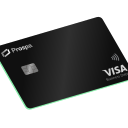
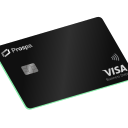
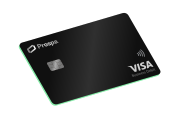
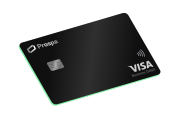
- Prospa Business Account: Open a Prospa Business Account and switch on Prospa Rewards to earn 1 Prospa Point for every $1 paid on eligible payments via BPAY, bank transfer or a Prospa Visa Business Debit Card. Fees apply.
- Bring your own card: Pay business bills using your own Australian issued Amex, Visa or Mastercard, even when card payments aren’t usually accepted. Switch on Prospa Rewards to earn 1 Prospa Point for every $1 you pay and if you use a rewards card like Amex, you’ll earn their points too. Fees apply.
Once you start earning Prospa Points through your payments, you can then redeem Prospa Points for a range of gift cards from iconic brands, or convert for Qantas Points with Qantas Business Rewards (2 Prospa Points for 1 Qantas Point). Terms apply.
The result? Business owners unlock value from payments they’re already making.
“Rewards can help save on future operational expenses,” Flack says. “Rewards turn everyday business activity into something that can support growth.”
Thinking about rewards as a business tool
The most useful way to think about rewards is this – every point earned on a supplier payment or a daily transaction is value that can be reinvested. Over time, those points compound into meaningful benefits.
“Points shouldn’t just be seen as a perk,” Flack says. “It’s like a rebate on your business. It’s a way to take that benefit to the bottom line.”
For business owners who haven’t looked into what rewards programs can really offer, the starting point is to look at where your business is already spending. Then you should ask whether those transactions could be earning you something in return. Chances are, they absolutely can.
The businesses getting the most out of rewards aren’t doing anything unusual. They’re just doing their due diligence that the financial decisions they’re already making are working as hard as possible.
Find out more about Prospa Rewards.