
At a glance
- Bill payment services let you pay supplier invoices, rent, utilities and government bills by card, even when the biller only accepts bank transfer or BPAY.
- Your card is charged while your biller receives a standard bank payment, without changing how they invoice or receive payments.
- Paying by card can help manage cash flow by allowing you to take advantage of available interest-free periods and earn rewards.
Chances are you already put what you can on the business card. Fuel, software, the odd supply run: it helps cover the gap between when money comes in and when it has to go out, the balance settles when your statement does, and the points add up. But your biggest costs never make it onto the card: the $20,000 supplier order can only be paid to a BSB, the rent goes out by direct debit, and the ATO wants a payment reference number. So the payments that would benefit most from that breathing room leave your account the day they’re due.
This guide explains how you can pay those bills by card too, even when the biller doesn’t accept cards, what it costs, and how your card’s interest-free period can work as a cash flow tool.
How can you pay a supplier that doesn’t accept credit cards?
You use a bill payment service that sits between your card and your biller. You pay the service by card, and the service pays your biller by bank transfer or BPAY. Three things make this work:
- Your biller receives a normal bank payment with the invoice reference they expect. They don’t need to accept cards, sign up to anything, or change how they invoice you.
- Your card is charged for the bill, so the payment lands on your card statement like any other purchase.
- The service charges a fee for making the switch, so the question on any given bill is what you get back for it: timing, rewards, or both.
What does paying bills by card do for your cash flow?
It shifts when the money leaves your account. Pay a bill from your bank account and the cash is gone the day it’s due. Pay the same bill on a credit card and it settles when your card statement falls due instead, and depending on your card issuer’s terms, that gap can be interest free.
For a business with lumpy income, that gap makes all the difference. An invoice that lands in a quiet week can be paid on time now and settled from your account after the busy fortnight that follows. And in the weeks when everything falls due at once, moving one or two large bills onto a card can spread the pressure of a big payment week without asking anyone to wait. If you’re not sure where your tight weeks fall, a cash flow forecast shows you before they arrive.
The length of any interest-free period is set by your card issuer and varies from card to card, so check your card’s terms rather than assuming one applies. It also only works if you pay your statement balance in full, because interest charges on a carried balance can quickly outweigh the timing benefit. The value comes from shifting when your existing bills get paid. Spending more to chase the benefit works against you.
Bring your own card to Prospa, step by step
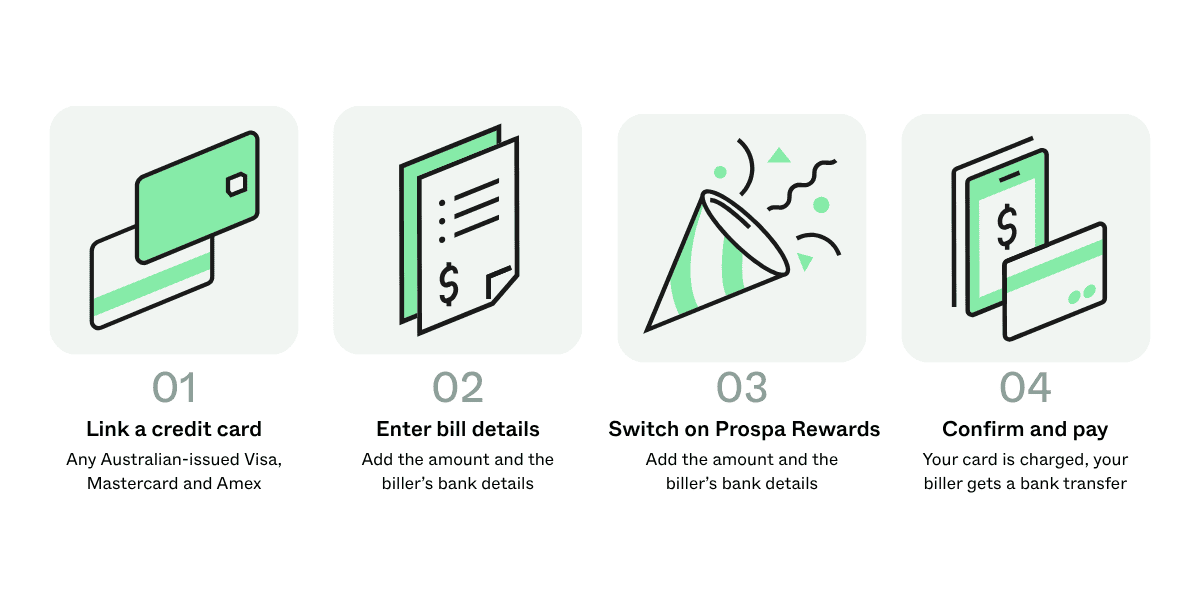
Prospa offers this service, with a bonus: you don’t need to sign up for a new card, you just bring the one you already own. Prospa sits between your credit card and your biller’s bank account. You’ll need a Prospa Business Account to link a card, and from there a payment runs like this:
- Link a credit card. Any Australian-issued Visa, Mastercard or Amex credit card you already own. Debit cards work too.
- Enter the bill details. Add the amount and the biller’s bank account details straight from the invoice, even if they don’t accept card payments.
- Switch on Prospa Rewards if you want to earn Prospa Points on the payment. Fees apply.
- Confirm and pay. Prospa charges your card, pays your nominated payee, and the transaction appears on your card statement. Processing takes up to 2 business days, so lodge larger bills a couple of days ahead of the due date.
From your card to their bank account
Say your electrical business owes a wholesaler $9,400 and the only payment details on the invoice are a BSB and account number. You add the invoice, pay with your Amex, and within 2 business days the wholesaler receives a bank transfer for the full $9,400 with your reference attached. On their end, you’ve paid the way you always have. On yours, the bill now sits on your card.
What business bills can you pay by card?
Supplier invoices, rent, utilities and government bills can all be paid through Prospa with a card you already own, whether or not the biller accepts cards.
Supplier invoices. Stock, materials, wholesale orders, equipment: the invoices that arrive with a BSB and a payment term, and rarely a card option.
Rent. For many businesses the single largest fixed cost, and almost always collected by direct debit or EFT. You can pay rent with a credit card you already own while your agent receives a transfer like any other tenant payment.
Utilities. Power, water, internet and phone all run through the same process.
Government bills. ATO payments work the same way, including BAS, PAYG and income tax. If that’s your main use case, our guide to paying your BAS by card covers it step by step.
What does it cost to pay bills by card?
Prospa charges a platform fee per payment, shown in full before you confirm. It has two parts: a servicing fee that varies by card type, 1.2% + GST for Visa and Mastercard and 2% + GST for Amex, and a separate 1% + GST Prospa Rewards fee per transaction while rewards are switched on, which you can turn off at any time. Fees are calculated on the bill amount, and your biller receives the bill amount only.
These fees are separate from the card surcharges some merchants add at checkout, which are banned from 1 October 2026: a surcharge is a cost a merchant passes on for accepting your card, while these are fees you choose to take on so you can pay a biller that doesn’t accept cards at all.
Can you earn rewards on business payments?
Yes, and a card payment made through Prospa can earn in two ways at once:
- Your card’s own points. Pay with a rewards card like Amex and you earn your card’s full points on the payment, subject to your issuer’s terms, because the charge is a normal card purchase and your card’s earn rules treat it as one.
- Prospa Points. Switch on Prospa Rewards and you earn rewards on business payments you’re already making: 1 Prospa Point per eligible $1 paid (T&Cs apply). Points can be redeemed for gift cards from iconic brands including JB Hi-Fi, Officeworks and Mitre 10, or converted to Qantas Points at 2 Prospa Points to 1 Qantas Point through Qantas Business Rewards.
Pay bills with the card you already have
The week everything falls due is the worst time to be setting up a new way to pay. Link a credit card you already own to Prospa, and be ready before the next bill you can’t put on a card lands.