
At a glance
- From 1 October 2026, businesses can no longer add a surcharge to eftpos, Visa or Mastercard payments, while wholesale card acceptance fees reduce at the same time.
- Around 84% of merchants do not surcharge and could benefit from lower payment costs if their provider passes on the fee reductions.
- Businesses that currently surcharge will lose that revenue stream and may need to review pricing before the changes take effect.
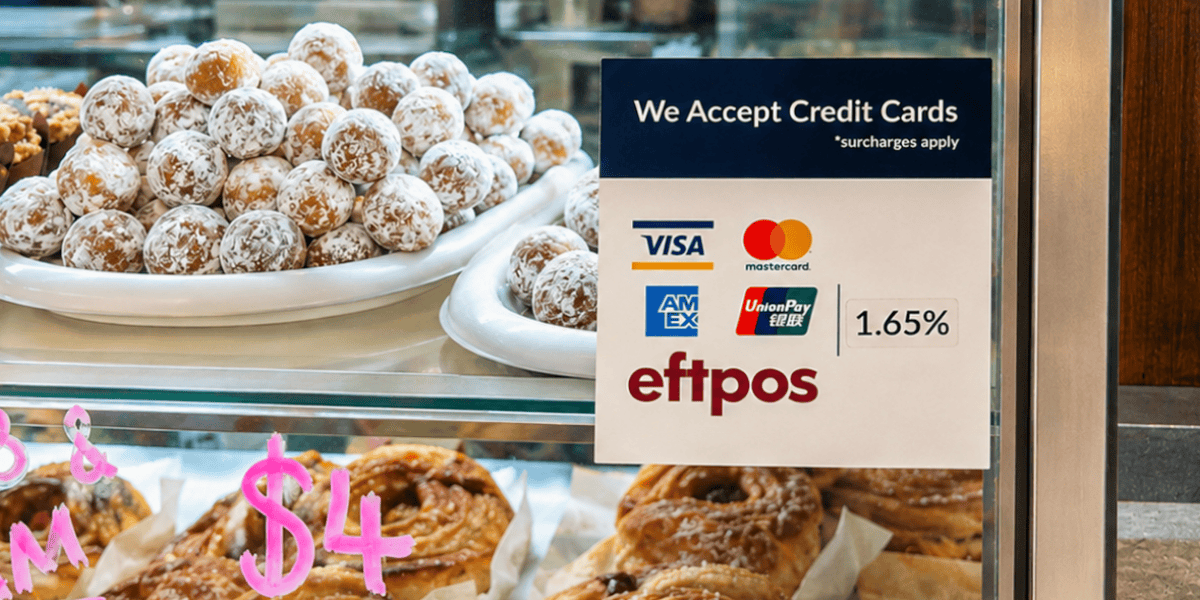
Maya Levy runs about 10,000 transactions a month through the terminal at Edgy’s Cafe in Edgecliff, Sydney, and barely one in ten of them is cash. Card payments carry a 1.65% surcharge that the machine adds automatically, but that stops from 1 October 2026, when the surcharge ban comes into effect.
For two decades, businesses have been free to pass card costs on to customers. The RBA’s review of card payment costs concluded surcharging no longer does what it was meant to do, which was to steer customers towards cheaper ways to pay. Cash use has fallen away, and many businesses add the same flat surcharge to every card, so there’s no cheaper option left to choose.
The ban lands alongside a second change, a cut to the wholesale fees businesses pay to accept cards, and what the two mean for you depends on whether you surcharge, or absorb card costs the way most businesses do. To see how owners on each side are preparing, we spoke with Maya and with James Scott, chartered accountant and Managing Director of JD Scott + Co.
The savings depend on your payment provider
The ban doesn’t come as a law against surcharging. Instead, the RBA is removing the rule that has stopped card networks from banning it, and Visa, Mastercard and eftpos are expected to add no-surcharge terms to the agreements businesses sign to accept cards. The practical effect for you is simple: from October, the surcharge line disappears from your customers’ payments.
The one exception is Amex, which runs its own network outside these rules and will be looked at in a separate review. In practice, many businesses set one flat surcharge across every card, so everything stops together anyway.
The second change targets interchange fees, wholesale costs paid between banks on every credit or debit card payment and the biggest ingredient in what you pay to accept cards. The cap on consumer credit cards is dropping from 0.80% to 0.30%, and the debit cap from 0.20% to 0.16%.
Together with a cap on foreign-issued cards arriving in 2027, the RBA expects the changes to lower merchants’ card costs by around $910 million a year, with small businesses gaining most because they tend to pay closer to the caps than large retailers. None of that guarantees your own costs will fall. The saving only reaches you if your provider passes the cheaper wholesale fees through, and nothing obliges them to.
Maya’s provider has been in touch about one half of that equation. “They sent me a text saying, don’t worry, we’ll stop the surcharge for you. That was it,” she says. “Nothing about what I’ll be paying, nothing about my fees coming down. So I’m planning as if nothing changes, and if the fees do drop, that’s a bonus. I’ll believe it when I see it.”
Plenty of owners will take the same line, planning around today’s fees and counting any cut as a pleasant surprise. “That conservative approach can’t hurt,” James Scott says, “but if you’re a high-volume, low-margin business trying to price effectively, asking your provider for an exact number now will help you get your pricing right before the deadline.”
The RBA says most businesses will come out ahead
Around 84% of merchants don’t surcharge at all, according to the RBA’s review. If that’s you, you’ve been absorbing the cost of accepting cards, folding it into prices or wearing it in your margin, and the fee cuts should shrink that cost without you touching your pricing.
Owners who have watched card fees creep up for years may take some convincing. “They say this was done for small business,” Maya says. “From where I stand, I’m still waiting to see what actually gets cheaper for us.”
James’s suggestion is to test it on your own numbers once the changes take effect, by comparing your October statement against September to see whether the reduction has come through. “If you’re on a flat rate, or your fees aren’t clear, now is a good time to ask your provider for a fee breakdown,” he says.
Switching providers is the other option. Maya has no plans to move, and it has little to do with price. “I like this machine. Ask me how many chicken avocados I sold on the 24th, and I can tell you,” she says. For owners who do want to compare, that’s getting easier too: providers will soon have to publish how much of the interchange reduction they pass on.
For businesses that surcharge, it is a harder call
Maya has sat on both sides of the fence. For years her cafe absorbed its card costs, around $1,000 to $1,200 a month on her old bank plan. When she moved to her current provider, the terminal came with surcharging built in, and the cost shifted to her customers.
From October it shifts back. She expects the invoice to run around $1,500 a month or more. “That’s fifteen, twenty thousand dollars a year I have to find,” she says. “So I’ll put my best-sellers up 20 or 30 cents. We’re cheaper than the cafes around us anyway.”
For the exact figure, James suggests working it out from your own books: take last year’s surcharge income as a percentage of sales, and that’s roughly how much prices need to rise to cover the change. Picture a $5 coffee: with the surcharge, customers were already paying about $5.08, so a new price of $5.10 changes almost nothing at the till.
“Surcharges follow the same GST treatment as the supply. If a product is subject to GST, like a coffee, the surcharge on top of the price is as well,” he says. “So there will likely be no impact to your books if the former surcharge is folded into the new pricing.”
Discounting survives the ban, too. Offering a lower price for cash, or for any payment method you prefer, remains allowed. And if the amount you need to recover is large enough to strain your cash flow, a cash flow forecast built before October will show whether you can absorb it, or need your new prices in place from day one.
You will stop paying surcharges too
“I’m happy about it as a consumer, not as a merchant,” Maya says. The ban cuts both ways for her: the surcharge she collects across roughly 9,000 card payments a month disappears, and so do the surcharges she pays everyone else. Like her, every owner pays them as a customer, on supplier invoices, software subscriptions, fuel and the hardware run. Businesses pay around $200 million a year in surcharges, according to the RBA’s review. Once the ban starts, those extra cents come off your outgoings too.
What it means for your rewards points
High interchange fees have long helped fund credit card rewards, and with that revenue shrinking, the RBA’s review notes some banks may respond by trimming the points or lifting the fees on personal credit cards.
If your personal card starts earning less, James suggests a simple test. “Always consider the economic benefit to you,” he says. “Does the cost you’re going to pay in terms of fees and interest make sense against the rewards and points that the card or program generates?”
Business credit cards are less affected, since their interchange cap isn’t changing, and Amex points sit outside these changes altogether. The costs that come with rewards programs, such as program memberships, card annual fees and fees charged to earn points can also be tax deductible, according to James: “You can claim these fees for business cards, as long as they are used for income-producing purposes. Keep records of these fees for tax time.”
Payments platforms like Prospa provide statements that show what you’ve spent on rewards fees, making them easy to pull together.
What to do before 1 October
“The biggest mistake is continuing to surcharge for payment methods covered by the ban,” James says. It sounds hard to get wrong, but most owners never set up their surcharge in the first place. A provider did it for them, and switching it off may not happen automatically everywhere. Maya’s provider has promised to handle hers. Check the terminal on the day anyway.
If your terminal does keep adding it, you won’t be fined: the ban lives in your merchant agreement, so continuing to surcharge puts you in breach of it. That’s between you and your provider, though the RBA has said it could recommend a legislated ban if surcharging continues.
A few more things worth doing before the deadline:
- Find your current card acceptance rate on your merchant statement or in your provider’s app.
- Ask your provider what your rate will be from October, especially if you run high volumes on slim margins.
- Compare your October statement with September to confirm the reduction came through.
- If you surcharge, work out your price rise from last year’s surcharge income as a share of sales.
- Consider whether a discount for your preferred payment method suits your business.
- Talk to your accountant now, not after the change lands.
However banks respond to the fee cuts, points don’t have to depend on their answer. With Prospa, your business can earn Qantas Points on funding, 1 point for every dollar funded on an eligible small business loan, up to 500,000 points, and on eligible everyday payments through a Prospa Business Account with Prospa Rewards.