
At a glance
- Payment providers passed on the fee cut unevenly, from Westpac lowering its flat rate to 0.79% to Square leaving its pricing unchanged.
- The surcharges on your own supplier bills have gone too, and the ATO will stop accepting credit cards after 30 November 2026.
- A look at your October statement will show whether your card costs came down, and a quick test payment will catch any surcharge that slipped through.
From 1 October 2026, businesses can no longer add a surcharge when a customer pays by eftpos, Mastercard, Visa or Amex, and the wholesale fees behind card payments came down on the same day. Payment providers, software companies, suppliers and banks have now made their first moves, and a few of those changes, from business card rewards to the ATO, weren’t on many owners’ radar.
Payment providers have cut fees by very different amounts
Each payment provider has taken its own approach to the merchant fees businesses pay to accept cards. Westpac cut its flat transaction rate from 1.20% to 0.79% for eligible new and existing customers. CommBank lowered its single-rate plan from 1.10% to 0.99% for eligible customers. Stripe trimmed its standard domestic rate from 1.70% to 1.65%, plus 30 cents per online transaction, while Square kept its pricing unchanged.
Part of every merchant fee is a wholesale charge your provider pays to the bank that issued your customer’s card, and that’s the part the RBA has now capped lower. On a flat-rate plan, your provider charges one price for every card and decides for itself whether to pass the lower wholesale cost on to you, so the cuts above vary from provider to provider. On a plan that charges the wholesale cost plus a margin, often called cost-plus, the lower wholesale cost flows through to your fees.
Whatever your provider did, its new rate now applies to every card payment you take. If you used to surcharge, that rate now becomes a direct cost unless you build it into your prices, and the lower it is, the less you have to recover. To calculate how much that is for your business, read our card surcharge ban article.
Most surcharges have been switched off automatically
Square, Tyro and Stripe removed surcharging from their systems when the ban started, so most merchants didn’t need to do anything. Xero updated unpaid invoices that went out with a surcharge before the deadline, so a customer paying one now pays the invoice amount and nothing more.
Automatic switch-offs only cover surcharges set up in the provider’s own system. Two kinds may still be running:
- Surcharges added by a POS system. If your point-of-sale software adds the surcharge before the payment reaches the terminal, those settings need to be checked separately.
- Surcharges entered as a different charge. A surcharge created as a service charge, a tax or an automatic tip has to be removed manually.
Any extra fee charged only because a customer pays by card counts as a surcharge, whatever it’s called. Weekend, public holiday and booking fees that apply however a customer pays are unaffected.
Businesses that surcharged are adjusting their prices
Around 16% of merchants surcharged card payments in 2024–25, according to the RBA’s review, and initial media coverage shows some businesses are already raising prices to cover the cost.
How much you need to recover depends on what you used to surcharge and on your provider’s new rate, which is why two cafes on the same street can land on different prices. Discounts for particular payment methods are still allowed, if you’d rather encourage a cheaper way to pay than lift prices across the board.
While new prices take shape, a cash flow forecast shows how long you can carry the cost.
The bills you pay are changing too
The surcharges you paid as a customer have gone, from supplier invoices and software subscriptions to filling up the tank. Card payments between businesses aren’t exempt from the ban unless a card network’s rules or a law provides an exemption. A supplier that used to surcharge you faces the same choice as any other business, so the cost may reappear in their prices.
The ATO no longer charges a card payment fee and will stop accepting credit cards after 30 November 2026, a decision it says follows the RBA’s review. If you pay tax or a payment plan instalment by credit card, Bring your own card lets you keep doing that after the cut-off. Our guide to the ATO change covers the other options.
Banks have changed business card rewards
The RBA kept the cap on the fee banks earn from business credit card payments at 0.8%, so business cards were expected to escape the rewards cuts hitting personal cards. Several banks changed them anyway.
Westpac raised the earn rates on its Altitude Business cards from 30 September and increased the points needed for some rewards, so check what your usual rewards now cost before judging whether your card earns more. ANZ shortened the interest-free period on its Qantas Business Rewards and Business Black cards to up to 44 days, starting with statements issued from 5 October.
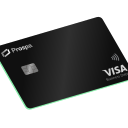
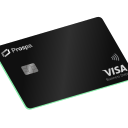
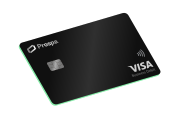
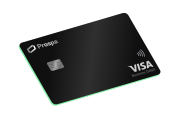
Personal rewards cards have seen wider cuts to earn rates, fees and benefits as issuers adjust to the lower consumer interchange cap. Prospa Rewards earn rates haven’t changed, with points earned on eligible payments from a Prospa Business Account or through Bring your own card.
What to check in your business now
A few checks will show where the change has landed for you:
Your post-ban checklist
0 of 5 done
All checked. You’re across the changes.
Room to adjust while prices catch up
The cost of accepting cards moved on 1 October, while prices and provider fees are still settling. A business line of credit makes the wait easier: you draw funds when you need them and repay as your pricing catches up.
Estimate your repayments with our line of credit calculator.