Executive Summary
Australian small businesses are facing the most significant change to how employers pay super in a generation, and cash flow confidence has dipped to its lowest point this year. Yet, beneath the surface concerns, the numbers reveal a story of resilience and steady performance.
Prospa’s Autumn FY26 SME Pulse highlights a growing disconnect between sentiment and actual trading performance. While the Prospa SME Confidence Index has dropped 10 points in just three months, our customer data shows that revenues and lending behaviour remain steady year-on-year. Businesses are maintaining the same volumes, average loan sizes, and monthly revenue, even as confidence wavers.
This gap is important. Sentiment often shifts before behaviour, and right now, that difference is more pronounced than ever.
Three forces are pulling on confidence:
- Payday Super landed on 1 July 2026. Awareness has improved, but readiness has gone backwards. More SMEs say they’re not prepared today than three months ago.
- The card surcharging ban hits on 1 October 2026. Over half of merchants expect to lift prices in response.
- Inflation is still biting. 46% have raised prices in the last three months. 31% are about to.
But SMEs are not standing still. Half are now turning to AI to manage admin and forecast cash flow, and one in five are using it to predict cash flow gaps. This is a quiet but powerful productivity shift happening beneath the surface. However, the smallest businesses, especially sole traders, are lagging in adoption, cash reserves, and confidence. Here are the five numbers that matter most.
- 60% of SMEs feel confident in their cash flow over the next 12 months. Down from 70% in February.
- $119,772 average monthly revenue across Prospa’s customer base in Autumn. Up 1.5% year-on-year.
- 36% of SMEs are not aware of, or don’t understand, the 1 July Payday Super change.
- 49% of SMEs are now using AI to manage admin or forecast cash flow.
Cash flow Confidence Snapshot
The Prospa SME Confidence Index tracks how Australian small business owners feel about their ability to stay cash flow positive over the next 12 months. It’s a leading indicator of small business behaviour, and this quarter it has moved sharply.
Confidence Index, last three waves
| Wave | % Confident | % Very confident | % Not confident |
|---|---|---|---|
| September 2025 | 69% | 32% | 11% |
| February 2026 | 70% | 32% | 11% |
| May 2026 | 60% | 24% | 16% |
The May result is a statistically significant 10-point drop in three months.
The decline isn’t evenly spread:
- Retail and hospitality confidence sits at just 48%
- Professional services confidence holds at 69%
- Smaller businesses (turnover under $100K) sit at 52%, compared to 71% for both $100K-$999K and $1M+
The takeaway: The Confidence Index is the leading indicator. When it moves this much, we pay close attention to what comes next.
Revenues are holding. Lending is holding. Sentiment isn’t.
The story this quarter is the gap between sentiment and performance.
On the surface, SMEs are trading steadily. Prospa’s customer data shows Autumn FY26 Average Monthly Revenue at $119,772, up 1.5% on the same quarter last year ($117,944). The Summer to Autumn drop of 10.4% mirrors the seasonal pattern Prospa saw in 2025, when revenues fell 4.3% from Q3 to Q4. Autumn is, historically, a quieter trading quarter.
However, cash reserves are still tight, especially for the smallest businesses.
- One in seven (14%) SMEs have no cash reserves at all
- A further 17% have less than a month’s worth
- Australian SMEs have just 2.6 months of expenses covered on average
- Sole traders are twice as likely as non-sole traders to have no cash reserves at all (18% vs 9%)
On top of that, the share of businesses with less than a month’s worth of expenses covered is higher in retail and hospitality (24%), beauty and health (19%) and building and trade (15%), compared to just 5% in professional services.
This is the underlying vulnerability sitting behind the drop in confidence. When sentiment falters and cash reserves are limited, business behaviour can change rapidly.
The takeaway: Revenues are steady, but the financial buffer supporting them is slim, especially for the smallest businesses.
What SMEs are doing with their money
If sentiment signals what’s ahead, lending reveals whether concerns are turning into action. So far this quarter, that shift hasn’t happened.
Prospa’s customer data shows Autumn FY26 lending volumes are essentially flat year-on-year:
- Total originations: +1.7% YoY
- Total loans: –2.6% YoY
- Average loan size: $51,287 (+4.4% YoY)
This trend continued through Summer. Even with the usual seasonal dip in average monthly revenue, small business borrowing patterns have remained stable. Average loan sizes have shifted less than 1% from quarter to quarter.
Intent to access funds is steady
The YouGov data shows the share of SMEs expecting to access external funds over the next 12 months has held broadly steady since late 2025, after a spike in February:
- 30% expect to access external funds in the next 12 months (Feb 26: 34%; Sep 25: 31%)
- Average amount expected: $22,759 (Feb 26: $23,181)
- Non-sole traders are far more likely to intend to access funds (41%) than sole traders (24%)
- Among non-sole traders intending to borrow, average expected funding is $27,459, well above the sole trader average of $17,877
- Newer businesses (under 5 years) are the most likely to plan to access funds (45%), versus 28% of businesses 5-20 years and just 11% of those over 20 years
- Larger businesses (turnover $1M+) lead intent at 51%
The takeaway: SMEs continue to access capital at similar volumes to last year, and their intent to borrow remains steady. So far, behaviour hasn’t followed sentiment, but that could change.
The Payday Super Squeeze: awareness up, readiness down
From 1 July 2026, employers will need to pay superannuation on the same day as salary or wages. This is the most significant change to how employers pay super in a generation. Interestingly, while awareness is rising, readiness is actually slipping.
Awareness has grown
| Feb 2026 | May 2026 | |
|---|---|---|
| Aware and understand | 59% | 64% |
| Aware but don’t understand | 11% | 11% |
| Not aware | 30% | 25% |
A modest improvement, but more than one in three SMEs (36%) are still heading into the deadline without a clear picture of what it means.
Readiness has gone the other way
| Feb 2026 | May 2026 | |
|---|---|---|
| Fully or somewhat prepared | 67% | 63% |
| Not prepared | 19% | 23% |
| Unsure | 14% | 14% |
That’s the key point: SMEs are more informed about Payday Super, but many feel less prepared. As the deadline approaches, the practical challenges are becoming clearer.
And behaviour has already started to shift in sentiment
- 44% expect Payday Super to have one or more negative impacts on their business
- 24% expect increased cash flow pressure
- 18% expect additional administration burden
- 18% expect to need to update or adjust payroll systems
- 15% expect increased risk of late payments or penalties
- 19% have already delayed or reduced planned investments in response
- Among non-sole traders, that rises to 29%, almost three in ten
The flip side: 26% expect positive impacts, most commonly improved compliance and certainty (15%) and greater visibility over superannuation obligations (14%).
Industry exposure varies. Confidence in readiness is highest in professional services (74%), and lowest in retail and hospitality (57%) and beauty and health (55%), the same sectors running the lowest cash flow confidence.
The takeaway: Awareness is rising, but readiness is slipping. As the deadline nears, the challenge feels greater. One in five SMEs has already delayed or reduced investment to prepare, though this hasn’t yet appeared in lending data. The next quarter will be critical.
Pricing pressure and the surcharge ban
nflation remains a real challenge for SMEs, even if it’s no longer making headlines.
Almost half have raised prices in the last three months
- 46% of SMEs have raised prices in the last three months to offset rising input costs
- 33% raised prices slightly
- 11% raised them moderately
- 2% raised them significantly
- 31% haven’t yet, but are considering it
- Only 23% have no plans to raise prices
Building and trade is leading the charge. 72% have raised prices in the last quarter, compared to 41% in professional services and 43% in beauty and health.
Of those who’ve raised prices: 69% raised them on core products or services, 27% added or increased surcharges, 25% reduced or removed discounts, and 22% lifted shipping or delivery charges.
And the surcharging ban is about to add another layer
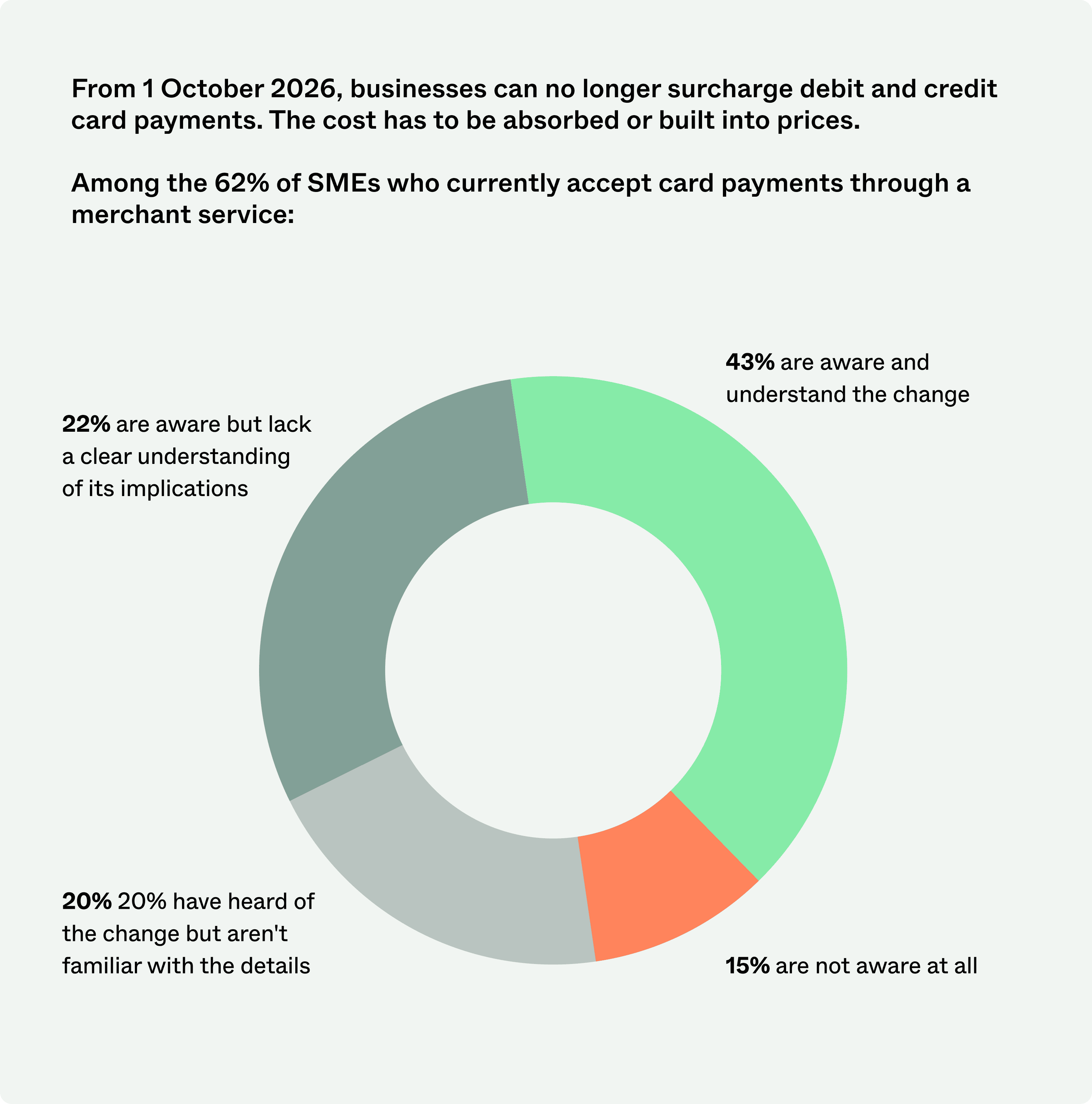
And on pricing impact:
- 54% expect the ban to affect how their business sets prices
- 13% expect to lift prices significantly
- 41% expect slight increases
- 40% will absorb the cost and keep prices the same
The takeaway: SMEs are managing pricing on two fronts, responding to inflation now, with more increases likely in October. For consumers, this means more price pressure is likely. For SMEs, it means margins are under pressure from both rising costs and regulatory change.
How SMEs are adapting: AI moves into the back office
Amid these pressures, there’s a positive productivity story emerging. Half of Australian small businesses are now embracing AI.
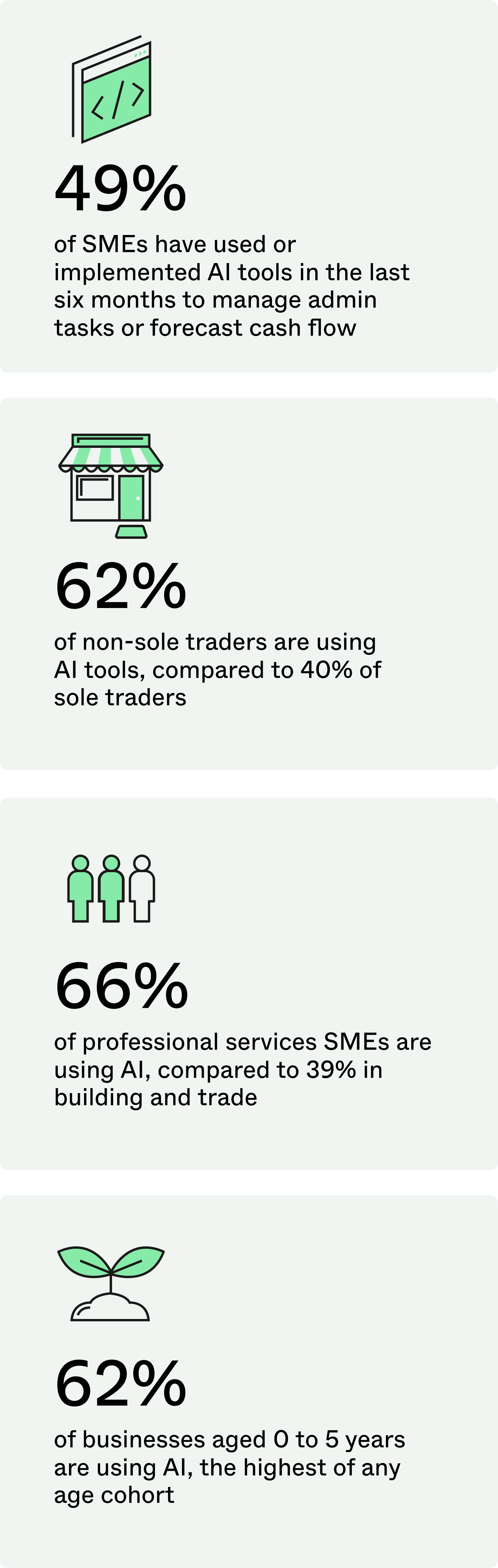
One of the most notable findings is the gap between sole traders and non-sole traders. The smallest businesses, who could benefit most from automation, are adopting it the slowest.
The most common tools are AI-powered assistants like Microsoft Copilot, ChatGPT and Google Workspace AI (34%), followed by operational tools (13%), AI built into accounting software (12%) and dedicated cash flow forecasting tools (10%).
What is AI actually doing for them?
- 40% automating emails, documents and routine admin
- 35% scheduling, reminders and task management
- 30% managing customer enquiries
- 28% categorising expenses and reconciling transactions
- 28% processing invoices and bills
- 20% forecasting cash flow or predicting cash flow gaps
The takeaway: AI adoption among SMEs has now passed the halfway mark. The current pressures are driving change faster than years of marketing ever could. However, the smallest businesses are still missing out. Helping them catch up is one of the biggest productivity opportunities in the SME sector today.
What this means
The Autumn FY26 SME landscape is defined by resilience in the face of pressure.
Revenues are flat. Lending is flat. Customers are still spending. Loan sizes haven’t shifted. Year-on-year, the numbers say small business is holding up.
Yet, there are clear warning signs beneath the surface. The Prospa SME Confidence Index has dropped 10 points. One in five SMEs have already pulled back on investment to prepare for Payday Super. Readiness for the change is slipping, even as awareness grows. Nearly half have raised prices, with another round likely in October.
Amid these challenges, half of Australian SMEs are quietly integrating AI into their operations. However, the smallest businesses are missing out. Sole traders are less confident, have fewer cash reserves, and are slower to adopt AI than their larger peers. This is where targeted support can make the biggest difference.
Looking ahead, the key question is whether sentiment will recover, or if the changes SMEs are making, like delaying investment, raising prices, and tightening cash management, will start to appear in revenue and lending data as well.
At this moment, the gap between sentiment and reality is significant. How that gap closes will shape the rest of FY26.
About Prospa
Prospa is a leading Australian fintech on a mission to simplify small business cash flow. We do this by building a platform that helps small businesses across Australia and New Zealand make payments, fund growth and reduce admin.
Since 2012, Prospa has helped more than 45,000 small businesses access over $5 billion in funding, working with a network of more than 25,000 brokers, accountants and aggregator partners.
Today, Prospa is more than a lender. Our Business Account, Visa Debit Card, Tap to Pay, Bill Pay and Xero integration help small businesses move money, manage cash flow and stay in control of every dollar. Through our partnership with Qantas Business Rewards, eligible customers can earn Qantas Points on Prospa Business Loans, with the ability to earn Qantas Points on bill payments coming soon.
By bringing lending, payments and rewards together, Prospa helps small businesses get more from every financial decision they make.
Prospa has also been recognised for its workplace practices, culture and values, certified as a Great Place to Work in Australia, a Great Place to Work in Technology, and a Great Place to Work for Women in both 2025 and 2026.
For media enquiries: [Insert contact details]
Methodology
This Pulse combines two data sources:
- YouGov SME Sentiment survey. Nationally representative online survey of 500 Australian business owners and primary decision-makers of businesses with fewer than 50 employees, conducted 30 April to 14 May 2026. Data weighted by business size and location. Significant differences reported at the 95% confidence interval. Compared to a February 2026 wave (N=500, fieldwork 29 January to 10 February 2026), and a September 2025 wave (N=502, fieldwork 25 September to 7 October 2025). ISO 20252:2019 accredited.
- Prospa customer data. Average Monthly Revenue (AMR), total originations, total loans and average loan size are drawn from Prospa’s internal customer dataset, covering Australian small business customers. Autumn FY26 = March, April, May 2026. Autumn FY25 = March, April, May 2025. Summer FY26 = December 2025, January, February 2026.