
A business line of credit gives your business ongoing access to funds you can draw, repay and reuse, with interest charged only on what you use. Here's how it works.
At a glance
- A business line of credit gives you a set credit limit you can draw from, repay and draw again as often as needed, without a new application each time.
- You pay interest only on the amount you've drawn, so an undrawn credit limit accrues no interest.
- It suits ongoing or unpredictable costs such as payroll, inventory purchases and bridging late invoice payments.
When you need funding, the hardest question a lender can ask is how much, because the honest answer is it depends on the month. Borrow too much and you’re paying interest on money sitting idle. Borrow too little and you’re back applying in three months. A business line of credit sidesteps the question: you get a limit and draw what the month actually requires.
What is a business line of credit?
A business line of credit is a flexible, revolving credit facility that gives your business ongoing access to a set pool of funds. You draw what you need up to an approved limit, repay it, and draw again, without a fresh application each time. You pay interest only on the amount you’ve drawn, so an undrawn limit accrues no interest.
Banks and online lenders both offer business lines of credit, with limits that range from a few thousand dollars to $500,000 with a lender like Prospa. Because the limit refreshes as you repay, it suits ongoing, hard-to-predict costs rather than a single planned purchase. And a committed facility like Prospa’s business line of credit is designed to stay open, so the funds are ready when a cost or opportunity lands.
How does a business line of credit work?
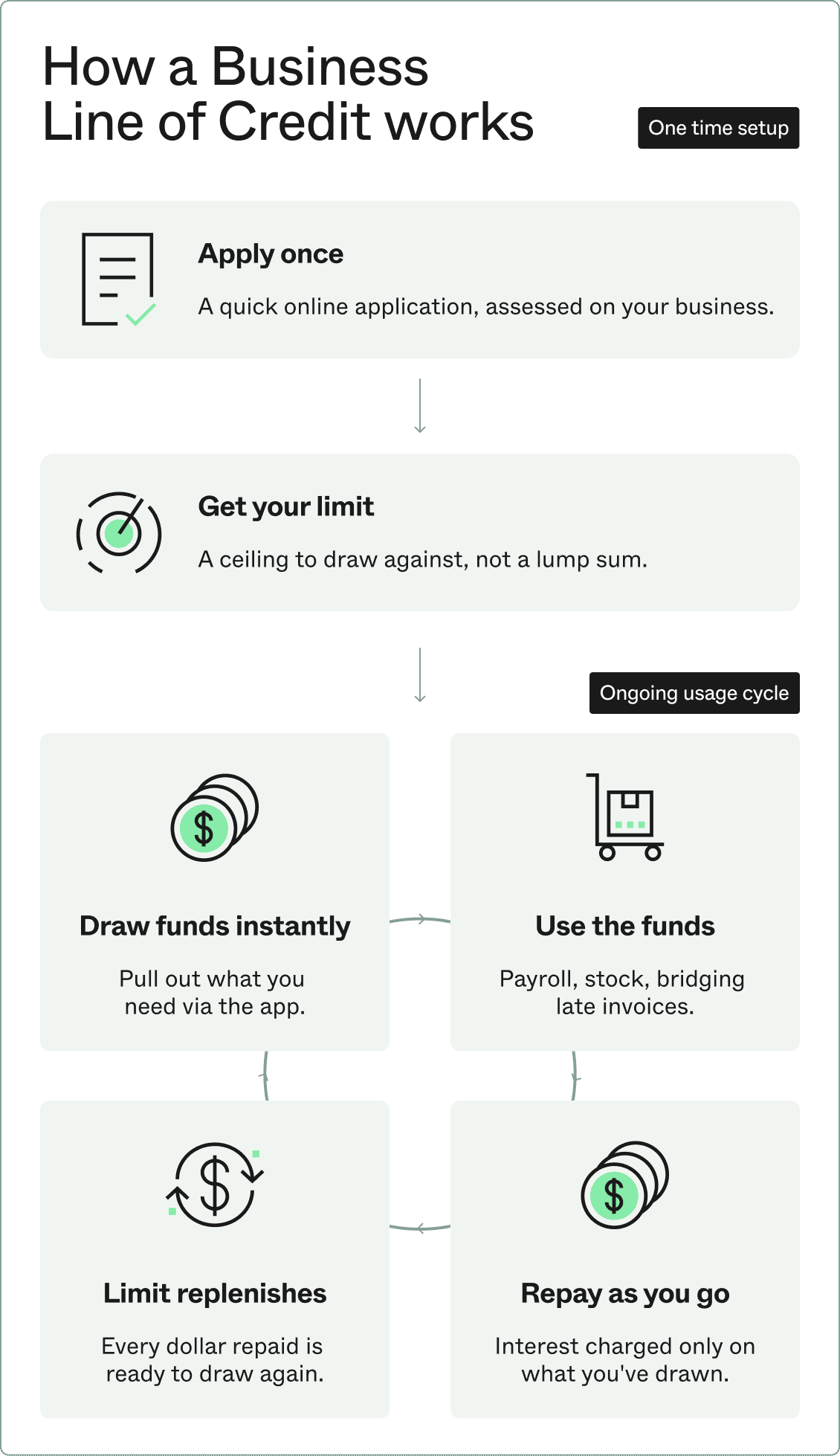
You apply once, the lender assesses your business, and you’re approved for a credit limit. That limit is the ceiling on what you can have drawn at any one time, not an amount handed over on day one. With Prospa, the application takes about 10 minutes online, and you can access up to $150,000 with no security upfront, assessed on the health of your business rather than your assets.
From there the cycle is draw, repay, redraw. You pull out what a given week or month requires, and every dollar you repay becomes available to draw again, with no new paperwork in between. How quickly the money reaches you varies by lender; Prospa drawdowns are instant through the Prospa App or Prospa Online, with no reassessment at the point you need the funds.
Interest and fees. A line of credit charges interest on the balance you’ve drawn, not on your full limit, so an untouched line accrues no interest. Most lenders add an ongoing fee for keeping the facility available, so it pays to compare products. Prospa charges a fixed interest rate on drawn funds, calculated daily, plus a weekly service fee of 0.046%, which on a $40,000 facility comes to less than $3 a day, with no origination or establishment fee. To see repayments and total interest for a scenario that matches your business, run the numbers through Prospa’s line of credit calculator and select Line of Credit on the product toggle.
A committed line of credit is designed to stay open rather than being re-approved at every draw; Prospa reviews the line with a check-in around every two years, and between check-ins the limit simply stays available.
How is it different from a business loan?
The difference comes down to whether you can plan the expense. A business loan hands you a lump sum you repay over a set term, built for a single investment you can see coming, like a fit-out or a large equipment purchase. A business line of credit keeps a limit available to draw on repeatedly, built for the costs you can’t schedule, where you can’t say in advance exactly how much you’ll need or when.
| Business line of credit | Business loan | |
|---|---|---|
| Structure | Revolving limit you draw, repay and reuse | One-off lump sum |
| Interest | On the drawn balance only | On the full amount borrowed |
| Repayments | Flex with how much you’ve drawn | Fixed over a set term |
| Best for | Ongoing, unpredictable cash flow needs | A single, planned purchase |
| Access | Stays available as you repay | Ends once the loan is repaid |
For a fuller breakdown, including how repayments and total cost compare, read Prospa’s guide to business loan vs line of credit.
What are the benefits and common uses?
A business line of credit puts the timing in your hands. You decide when to draw and how much, so you can move on a supplier discount the day it’s offered or cover a shortfall the week it appears, without applying all over again. And because what you repay is what you pay for, the facility costs you in proportion to how much you actually lean on it.
Most businesses use one for the moments when money has to go out before it comes in:
- Covering payroll when client payments run late, or when BAS, wages and supplier bills land in the same week
- Buying inventory ahead of a busy season or to secure a bulk discount
- Paying suppliers on time to protect terms and relationships
- Smoothing quieter months without dipping into personal funds
Because the limit refreshes, a line of credit is easier to lean on than a fixed loan, so it works best with a plan for paying down what you draw; steady repayments also keep your credit score healthy. Fees apply for ongoing access whether or not you draw heavily, and interest on drawn funds adds up if a balance stays out for a long stretch. A business line of credit fits businesses with steady, recurring cash flow movement more than one-off borrowing needs.
Is a business line of credit the same as a business overdraft?
No, a business line of credit isn’t a business overdraft, though they serve the same purpose: funds on demand when a cost lands before the cash to cover it. The difference is in the structure.
| Business line of credit | Business overdraft | |
|---|---|---|
| Structure | A standalone facility with its own credit limit | Attached to your business transaction account |
| How you access funds | Draw down and move funds wherever you need them | Spend past a zero balance on that account |
| When you can use it | Any time, without your account being overdrawn | Only once the account goes below zero |
| Interest and fees | Interest on the drawn balance; with Prospa the rate is fixed and there’s no establishment fee | Interest on the overdrawn amount, usually at a variable rate, often with an establishment fee |
Who’s eligible?
Every lender sets its own bar, usually a mix of trading history, turnover and the strength of your cash flow. For a Prospa business line of credit, you’ll need at least 2 years of trading history and a minimum of $6,000 in monthly turnover.
No asset security is required upfront to access up to $150,000, and provided you keep meeting your obligations, it won’t be required later either. For funding above $150,000, or where your combined funding across Prospa products crosses $150,000, property ownership is required and asset security may be too.
How do you apply for a business line of credit?
Most lenders now take applications online, and the process is quicker than many owners expect. With Prospa, it takes about 10 minutes.
- Check you meet the basics. Confirm you’ve been trading at least 2 years, with monthly turnover of $6,000 or more.
- Gather your details. Have your ABN, business details and around 12 months of business bank statements ready. Prospa uses these to assess the health of your business rather than asking for upfront security to access up to $150,000.
- Apply online. Complete the application on Prospa’s business line of credit page, or speak with a Business Lending Specialist if you’d like to talk it through first.
- Get a decision. Most applications get a response within 24 hours, sometimes within a few hours, and if you’re approved you’ll receive a credit limit to draw against.
- Draw when you’re ready. Once you’re set up, you draw funds through the Prospa App, repay as you go, and reuse the limit as needs arise.
Explore Prospa’s Business Line of Credit or line of credit calculator to estimate repayments and costs.